If you're going to be in San Antonio this weekend, I'll have a table at the Saxet Gun Show at the San Antonio Events Center. I'll have some blades, some non-blades, some pictures, and will be sharing the table with Tobin Nieto, another Neo-Tribal Metalsmith.
Hope to see you there!
Schedule:
Saxet Gun Show
Map:
San Antonio Events Center
Wednesday, August 3, 2011


Monday, August 1, 2011
Owner review of bush sword
Here's what the new owner had to say after playing over the weekend with the bush sword I traded for the bullwhip. Check out the awesome sheath he knocked together for it!
"Last month, Stormcrow on the Hoods Woods forum, made one of his Bush Swords to trade for one of my paracord bullwhips.
I received the Bush Sword Friday after work. Upon opening the box, I knew that what I held in my hands was something I was going to be using for a long time. To describe it to someone who has never held it, I would say it is somewhere between a short machete and a large chopping knife. It has the light weight of the machete, but the strength of the chopper. I know both the machete and the large knife chop stuff, but there is quite a difference between a machete and a Becker BK9. This Bush Sword would fit the place in between the two. This thing came shaving sharp. I actually nicked my finger through the cloth I was cleaning it with after use.
I was too excited to get out the measuring tape to get dimensions. I will post those tomorrow for those interested.
One thing I noticed was, like me, it came to this world naked. Being a hobby-leathercrafter, I had to clothe this big fella. I used 10 oz veg tan leather, added some D-rings, and made a srap to wear either belt or baldric style.
Now for some testing review. My dad recently began removing a fencerow filled with 40 years of trees and brambles. He had a large pile of both green and well-seasoned trees.
The first thing I did was find a branch about 5 inches in diameter. I am not sure of the species. I hacked through this in just a couple of minutes. Each hit dug deep.

I noticed a mostly dry, thumb-sized stick was in the way, so I let the Bush Sword eat. I slashed at it at a severe angle and severed it with one swipe.

Next, I found some really dry pine, and made a fuzz stick. With the Bush Sword being a light as it is, it offers many holding options. I used every part of the blade to make the fuzz stick, just to see what options I had.

Overall, I am really impressed with this primal little giant.
Tony"
"Last month, Stormcrow on the Hoods Woods forum, made one of his Bush Swords to trade for one of my paracord bullwhips.
I received the Bush Sword Friday after work. Upon opening the box, I knew that what I held in my hands was something I was going to be using for a long time. To describe it to someone who has never held it, I would say it is somewhere between a short machete and a large chopping knife. It has the light weight of the machete, but the strength of the chopper. I know both the machete and the large knife chop stuff, but there is quite a difference between a machete and a Becker BK9. This Bush Sword would fit the place in between the two. This thing came shaving sharp. I actually nicked my finger through the cloth I was cleaning it with after use.
I was too excited to get out the measuring tape to get dimensions. I will post those tomorrow for those interested.
One thing I noticed was, like me, it came to this world naked. Being a hobby-leathercrafter, I had to clothe this big fella. I used 10 oz veg tan leather, added some D-rings, and made a srap to wear either belt or baldric style.
Now for some testing review. My dad recently began removing a fencerow filled with 40 years of trees and brambles. He had a large pile of both green and well-seasoned trees.
The first thing I did was find a branch about 5 inches in diameter. I am not sure of the species. I hacked through this in just a couple of minutes. Each hit dug deep.

I noticed a mostly dry, thumb-sized stick was in the way, so I let the Bush Sword eat. I slashed at it at a severe angle and severed it with one swipe.

Next, I found some really dry pine, and made a fuzz stick. With the Bush Sword being a light as it is, it offers many holding options. I used every part of the blade to make the fuzz stick, just to see what options I had.

Overall, I am really impressed with this primal little giant.
Tony"
Friday, July 29, 2011
Another bush sword trade
While I have done all right getting the general idea of my blades across with my photos, I'm certainly no photographer. I will put together a relatively decent composition, but my camera will not really capture all that is going on.
Well, I traded a bush sword for some photography. :D These are all pieces that have been up before, but they are looking much...better now.
This is what I traded:


And this is what I got:


More forthcoming. :)
Well, I traded a bush sword for some photography. :D These are all pieces that have been up before, but they are looking much...better now.
This is what I traded:


And this is what I got:


More forthcoming. :)
Thursday, July 28, 2011
Get a grip!...on an integral socket handle. :)
I've recently had a couple of people asking about a longer socket handle to be able to get a two-handed grip on it. Not trying to dissuade anyone from a longer grip, but I just wanted to demonstrate that by making use of the generous choil I like to put on 'em, one can get a pretty solid hand-and-a-half grip on all of the bush swords I've made recently. Even with gorilla paws like mine.
From the shortest...

...to the longest.

See?


These are intended for one-handed wielding, but they are capable of two-handed chopping if need be. I wouldn't use this kind of a grip to stab, though. :(
Thanks! :)
From the shortest...

...to the longest.

See?


These are intended for one-handed wielding, but they are capable of two-handed chopping if need be. I wouldn't use this kind of a grip to stab, though. :(
Thanks! :)
Monday, July 25, 2011
Official adoption of the term "bush sword"
With my large socket-handled blades, I've gone back and forth between calling them "machetes" and "bush swords". I've been giving it some thought, and I've decided to officially settle on the term "bush sword" for what I make. Here's the reasoning:
I've spent much time clearing brush. I've used primarily machetes, axes, and billhooks for this task, and love each of the tools for their own different approach that allows the user to tackle just about any brush problem between the three of them. One of the major things I wanted to be able to do when I began blacksmithing was to make my own machetes.
The machete is one of the most useful brush tools available. It is also typically the cheapest and most poorly made. A well-made machete will tackle jobs that you would normally reach for an ax to do, while still whacking through whippy, thorny tangle that would likely slide up your ax handle and rip your hands to hamburger if you tried it. Many of the machetes that you come across in stores in this country are uncomfortable, poorly shaped, and only have the slightest beginning of a bevel, without even attempting to come to an edge. Even some of the more expensive of these cheap tools require extensive re-working to get a satisfactory edge. Machetes, for all their usefulness, have a bad connotation.
So now that I am able to make my own machetes, I find that what I make is vastly different from what one typically thinks of when hearing the term. They are built on a different principle, with a somewhat thicker, shorter blade and a profile and multiple distal tapers that create a powerful chopping blade that still deals handily with the thin, whippy, thorny branches that would simply bounce out of the way of an ax before slapping back at the tool user. They also tend to use integral socket handles, which I first discovered when bladesmith Tai Goo began to use them. His point of reference was the blades made and used by the Igorot headhunters of the Philippines. Since then, I have discovered it is a multi-cultural thing, covering much of eastern Asia and also found in Oaxaca, Mexico. I'm sure there are more places that make use of them than I am aware of.
Looking at the various Filipino blade designs, one sees a dual purpose to many of them. They are both tools for agriculture and working in a jungle environment, and simultaneously effective weapons for fighting.
At the same general time I learned of integral socket handles, I became aware of the term "bushcraft", used to describe (according to the Oxford dictionary) "skill in matters pertaining to life in the bush". I would define it as I have seen it applied as something along the lines of "a philosophy of outdoorsmanship focusing more on individual skills and quiet particiapation in nature than on gear". Your mileage may vary. Gear is of course important to bushcrafters, but they try to use less of it and to make sure that what they do have is comfortable, functional, and of high quality. Hand crafted gear from natural materials is generally preferred when possible.
Combining all of these ideas, you can see where the term "bush sword" would grow. I didn't coin the term and I don't remember where I first saw it, but I think it fits well with what I am trying to do: make beautiful, quality hand tools with a definite capability of being effective weapons, using natural materials where possible. Whether traveling through a jungle in South America or fighting your way through an onslaught of zombies, one of my bush swords would be equally handy and fitting.
So there you go. I'm callin' 'em as I see 'em. Bush swords. :)

I've spent much time clearing brush. I've used primarily machetes, axes, and billhooks for this task, and love each of the tools for their own different approach that allows the user to tackle just about any brush problem between the three of them. One of the major things I wanted to be able to do when I began blacksmithing was to make my own machetes.
The machete is one of the most useful brush tools available. It is also typically the cheapest and most poorly made. A well-made machete will tackle jobs that you would normally reach for an ax to do, while still whacking through whippy, thorny tangle that would likely slide up your ax handle and rip your hands to hamburger if you tried it. Many of the machetes that you come across in stores in this country are uncomfortable, poorly shaped, and only have the slightest beginning of a bevel, without even attempting to come to an edge. Even some of the more expensive of these cheap tools require extensive re-working to get a satisfactory edge. Machetes, for all their usefulness, have a bad connotation.
So now that I am able to make my own machetes, I find that what I make is vastly different from what one typically thinks of when hearing the term. They are built on a different principle, with a somewhat thicker, shorter blade and a profile and multiple distal tapers that create a powerful chopping blade that still deals handily with the thin, whippy, thorny branches that would simply bounce out of the way of an ax before slapping back at the tool user. They also tend to use integral socket handles, which I first discovered when bladesmith Tai Goo began to use them. His point of reference was the blades made and used by the Igorot headhunters of the Philippines. Since then, I have discovered it is a multi-cultural thing, covering much of eastern Asia and also found in Oaxaca, Mexico. I'm sure there are more places that make use of them than I am aware of.
Looking at the various Filipino blade designs, one sees a dual purpose to many of them. They are both tools for agriculture and working in a jungle environment, and simultaneously effective weapons for fighting.
At the same general time I learned of integral socket handles, I became aware of the term "bushcraft", used to describe (according to the Oxford dictionary) "skill in matters pertaining to life in the bush". I would define it as I have seen it applied as something along the lines of "a philosophy of outdoorsmanship focusing more on individual skills and quiet particiapation in nature than on gear". Your mileage may vary. Gear is of course important to bushcrafters, but they try to use less of it and to make sure that what they do have is comfortable, functional, and of high quality. Hand crafted gear from natural materials is generally preferred when possible.
Combining all of these ideas, you can see where the term "bush sword" would grow. I didn't coin the term and I don't remember where I first saw it, but I think it fits well with what I am trying to do: make beautiful, quality hand tools with a definite capability of being effective weapons, using natural materials where possible. Whether traveling through a jungle in South America or fighting your way through an onslaught of zombies, one of my bush swords would be equally handy and fitting.
So there you go. I'm callin' 'em as I see 'em. Bush swords. :)

Bush sword traded for a bullwhip
A member of the Hoodlums forum posted a picture of a bullwhip that he had braided for himself. I immediately asked if he would consider trading one for a bush sword. He was equally happy to do so as I was to get one of his whips. I forged out the blade from leaf spring, spread the handle preform to get ready to roll it, then set it aside for a couple of days. I ended up using the preform to demonstrate socket-rolling for the June meeting for the Balcones Forge blacksmith group that I hosted in my shop, which was the reason I had saved it in the first place. The demonstration went well, and I rolled a rather nice socket.
Here's what the bush sword looked like after forging and clean-up grinding on the profile.

Then I had a series of unexpected delays hit me. The Hoodlum worked at his whip diligently and got it sent to me in the latter part of June. Turns out it is only the second one he has made. The core is 14AWG electrical cord, with the outer layers two-tone paracord. This thing cracks like a pistol going off if you know what you're doing with it, and raises a nice welt if you don't. :D Unfortunately I fall into the latter category, but I'm getting a little better at it.

Finally, I caught up with other stuff and got the bush sword finished. False edge, filed bevel, multiple quenches in veggie oil and multiple tempering cycles, hemp cord handle wrap with cotton cord double Turk's head knots sealed in amber shellac, sharpened until it shaves hair and slices through the tiny whippy branches smaller around than a toothpick.

And finally, a full set of gear for the eccetric archaeologist gentleman adventurer or cattleman on walkabout.

The bush sword is packed up and ready to go out in the morning mail.
Here's what the bush sword looked like after forging and clean-up grinding on the profile.
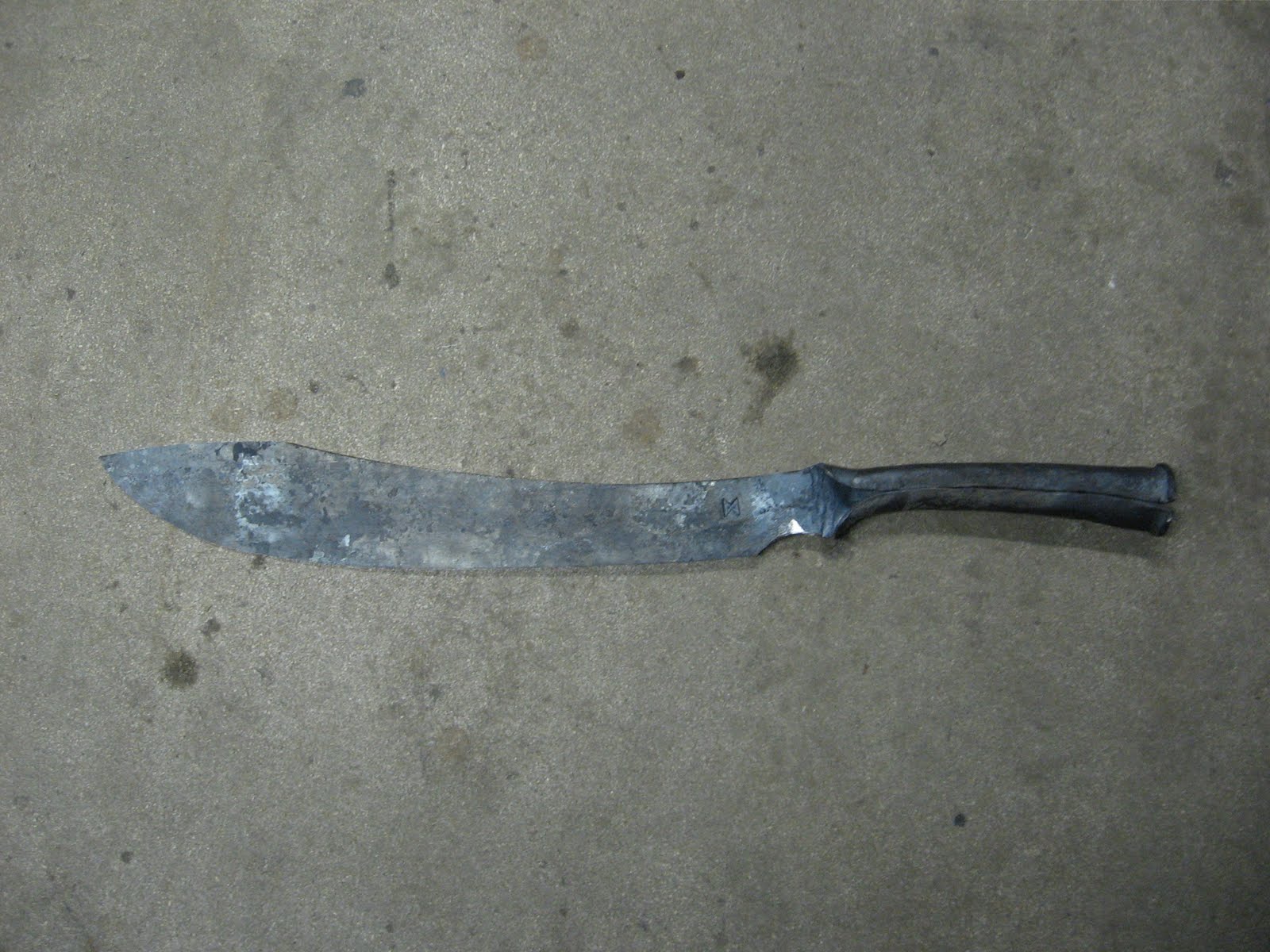
Then I had a series of unexpected delays hit me. The Hoodlum worked at his whip diligently and got it sent to me in the latter part of June. Turns out it is only the second one he has made. The core is 14AWG electrical cord, with the outer layers two-tone paracord. This thing cracks like a pistol going off if you know what you're doing with it, and raises a nice welt if you don't. :D Unfortunately I fall into the latter category, but I'm getting a little better at it.

Finally, I caught up with other stuff and got the bush sword finished. False edge, filed bevel, multiple quenches in veggie oil and multiple tempering cycles, hemp cord handle wrap with cotton cord double Turk's head knots sealed in amber shellac, sharpened until it shaves hair and slices through the tiny whippy branches smaller around than a toothpick.

And finally, a full set of gear for the eccetric archaeologist gentleman adventurer or cattleman on walkabout.

The bush sword is packed up and ready to go out in the morning mail.
Friday, July 22, 2011
Mean-looking blade
Just delivered this yesterday. The customer's request was: "Maybe something 12" long or so, forge finish and mean looking."
Here's what I came up with:

The blade is right at 12", and it is appropriately mean-looking. Forged leaf spring, multiple quenches in veggie oil, multiple tempering cycles, integral socket handle, hemp cord wrap, cotton cord double Turk's head knots at either end, sealed in black shellac.
He just couldn't wait to get it home and try it out on the feral bushes in his back yard. He had to whack at a cardboard tube.


This is a light, fast blade, as he commented. I like leaving a customer with a grin on their face as they heft their new blade. :)
Here's what I came up with:

The blade is right at 12", and it is appropriately mean-looking. Forged leaf spring, multiple quenches in veggie oil, multiple tempering cycles, integral socket handle, hemp cord wrap, cotton cord double Turk's head knots at either end, sealed in black shellac.
He just couldn't wait to get it home and try it out on the feral bushes in his back yard. He had to whack at a cardboard tube.


This is a light, fast blade, as he commented. I like leaving a customer with a grin on their face as they heft their new blade. :)
Subscribe to:
Posts (Atom)


