Tuesday, June 22, 2010

Kit knives

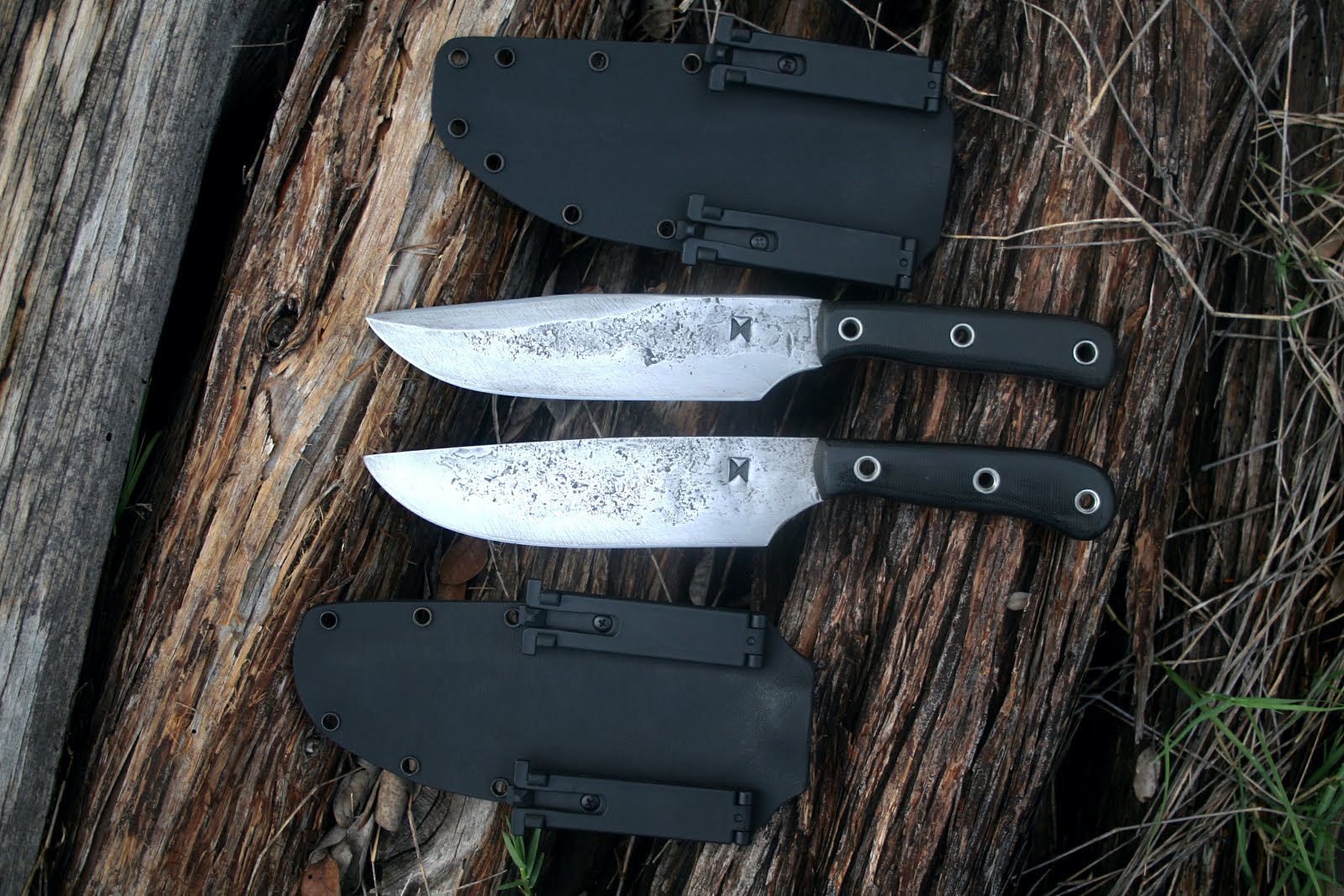
Sometimes I have a customer who wants a knife blade that they can put their own handle on: a custom kit knife. These are a couple that I have done. Both customers ordered a forge finish on the blades.

This is a seax and flint striker, forged from leaf spring and file, respectively. I also fitted up a copper guard for the seax, although it ins't pictured. Both guard and tang got left over-large so the customer could shape them down to fit the handle he made.


This was a Bowie that was recently commissioned from me. It, too, is leaf spring, quenched in vegetable oil and given a differential heat treatment. The guard is copper electrical bus bar. I like using salvaged materials when it makes sense. :) He plans a slab handle of worm-eaten but still solid American chestnut.

Monday, May 31, 2010

Neo-Tribal Razor


This razor was comissioned by a guy who saw pictures of a similar one I had made for myself last summer. This one is made from an old Nicholson file. The original was car spring. The file's higher carbon content should make it hold its edge longer. With the car spring razor, I had to strop the edge midway through a shave.

It was forged out, ground, hardened in vegetable oil, temper lightly drawn, honed, and stropped. The box is made by my neighbor and sometime student, Bryan Pope, whose fine ax I've already shown. It is made from salvaged red cedar, left rough.

Friday, May 7, 2010

Further variations on a theme


The pink-handled knife that I made for my girlfriend has been my most successful one so far in that it a.) actively discouraged some creepy guy lurking about in the college parking garage simply by her nonchalantly transferring it from her purse to her back pocket and b.) leading to several commissions from folks wanting similar designs.

One of those has already been posted here, the one with the forge finished blade and bodark and mesquite handle.

Well, the fellow who commissioned that has a nephew who is interested in knives. The nephew's family came to visit over the Easter holiday, and said customer had me help the nephew forge out a knife blade with my guidance. The nephew did quite well, doing over half of the forging on the blade, with me showing him the processes and then handing it over, and then doing tweaking as necessary. As is my custom on knives where I don't do all the work, I stamped my touchmark on the opposite side of the blade from where I typically do.

Unbeknownst to the nephew (but beknownst to us), we were actually making his early birthday present. I finished it out and now it's going to be mailed out to California this week to surprise him.

As with the uncle's knife, the blade is car coil spring, forged by hand. This time, I cleaned up the profile by grinding, but hand filed the cutting edge and false edge entirely instead of doing any grinding on it, leaving the main part of the blade forge finished as before. It was hardened in vegetable oil and tempered in a toaster oven. The guard is of railroad spike, the spacer is bodark (Texican for "Osage orange"), and the main handle is mesquite. The sheath is Kydex.

Here it is in comparison with the uncle's knife. It came out a bit larger, and I've learned better how to blend guards with handles since then. You can see how handling has darkened then wood of the uncle's knife.

Wednesday, April 21, 2010

Price Guide

THERE WILL BE AN ADJUSTMENT IN PRICES AFTER THE BLADE SHOW!  Read about it here:  http://helmforge.blogspot.com/2017/05/blade-show-2017-price-announcement.html

These are minimum prices. Depending on design, features, and materials, your price may be higher. Prices do not include shipping.

At this point I have no interest in making mirror or satin finished blades. I prefer the practicality and aesthetics of a forge finish, and frankly no customer has wanted to order anything from me that wasn't forge finished in a while. Every knifemaker has his area of focus, and mine will be on forge finished blades. Axes are a bit different and tend to have smooth-ground finishes.

A forge finish is easy to maintain and is difficult to damage. Many people, including myself, enjoy the primal look. A good forge finish displays the smith's skill with a hammer. It is smooth, showing no random hammer blows, textured only by the scale that forms from heating the steel to be able to hammer it into shape. I soak my forge finished blades in vinegar overnight in order to eat the scale off, leaving the textured steel exposed.

Steel will be 80CrV2 for knives and 4140 for axes, unless otherwise discussed. Handles can be wood, Micarta, natural cord wrap, or hardened paracord wrap. I make my own Kydex sheaths and work with several different leatherworkers to make make leather sheaths if desired.

Kydex sheaths are typically $40, not including carry hardware, with sheaths for longer blades starting at $50. Leather prices vary depending on maker and design. I have no markup on leather sheaths; typically I pay the leatherworker and then charge the customer what it cost me, although I will put a customer in direct contact with the leatherworker if so desired and they can pay directly if they would rather.

A fully sharpened top edge adds $30 to the base price for shorter blades, and $50 for longer blades.

$165 - 4"-5.5" knives. These are hand forged works of functional art. Very capable tools, they are also beautiful. I will work with you on design and materials to make your own knife that will serve you well the rest of your life. The knife will be delivered shaving sharp.

Cord wrapped handles start at $165 and Micarta or wood handles start at $185.


$185 - 6"-10" These are predominantly camp knives and fighters. Camp knives, used for chopping primarily, are typically balanced so that the blade is heavier. Fighters are more balanced between the handle and the blade, keeping them quick and lively in the hand in spite of the length of their blades.


Cord wrapped handles start at $185 and Micarta or wood handles start at $205.

$300+ - 10"+ Big choppers, machetes, and swords. Serious brush tools. Zombie killers.


Some options to consider:

Bolster - I put these on hidden tang knives but not on full tangs. The bolster is the metal support that strengthens the end of the wooden handle where the tang enters the wood. An actual bolster is the same basic cross section as the handle behind it. A single guard drops down on the edge side of the knife, helping keep the user's hand from sliding onto the blade. A double guard rides above the spine of the blade as well, really locking the user's hand from forward movement. I use either copper or steel for my bolsters and guards. A bolster will cost less than a single guard, which will in turn cost less than a double guard.

Lanyard hole - This allows you to add a lanyard for either added retention, aid in pulling the blade from the sheath, or simply decoration.

Handle material - There are many kinds of materials out there. Some of the most beautiful exotic hardwoods are also the most rare, and will have a higher materials cost.

The Wasteland Crow Project


For those of you not keeping up with the Wasteland Crow Project, these are the blades that I made for it: a golok with a 13.5 inch blade and a sharpened forward edge, and a small, pointy, very sharp companion. Noah, of Wasteland Leather, is busily putting together the beautifully corroded Apocalyptic Survivor carry system to go with them. Check out his in-progress pictures over at The Wasteland Crow Project.

Wednesday, April 7, 2010

Variations on a theme


This is another little everyday carry knife that was commissioned by someone who saw my girlfriend's knife and wanted something similar. This was actually made before the electrician's knife that was inspired by my girlfriend's knife.

The blade is forged from car spring, forge finished, with the cutting edge and false edge hand filed. The double guard is a flattened piece of railroad spike, and the handle is Osage orange (or "bodark" if you're Texan) and mesquite. The sheath is Kydex.

A forge finish leaves the texture of the oxidation (scale) that forms when the steel is heated. Some people like it, some don't. I like it. I find it a very durable finish, and a good way of adding visual interest. A well-done forge finish shows what the knifemaker is capable of doing with his hammer. Any mis-placed hammer stroke is going to show up for the whole world to see. A good forge finish is smooth, with no random dents from poor hammer control. It is simply a light texture from the scale. After forging a blade that I'm forge finishing, I soak it in vinegar overnight. The vinegar eats the scale off and leaves the steel unaffected.

The customer went from not carrying a knife for several years to carrying this daily.

Monday, April 5, 2010