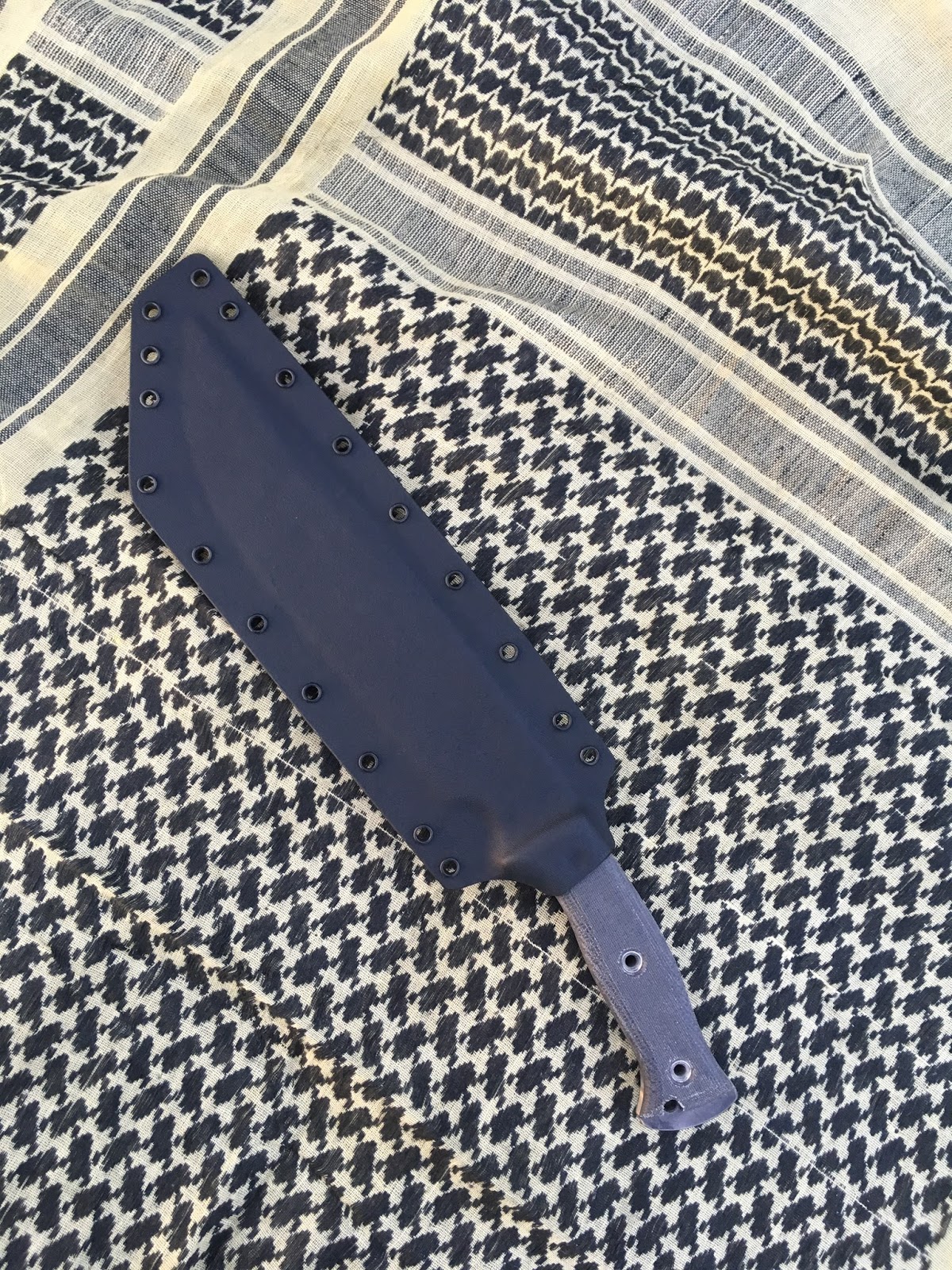
A guy who does bodyguard work for rock stars approached me about doing a short, cord wrapped knife for him. It seemed like an interesting project, so I took it. He wanted a 4" blade (about as short as I ever make) and 4" handle (shorter than I usually do), sharpened top edge, cord wrapped handle, but left the rest of it up to me. I took a few tips I've picked up from Ed Calderon and a bit of Spanish navaja influence, some pikal design, and came up with the Rooster Spur.
It's forged from 80CrV2 steel, with a hemp cord wrap over the bare steel of the tang.
It has a narrow little point for easy penetration. A two-strand Turk's head provides a mechanical lock for the hand to keep it in place when stabbing.
As mentioned above, it was designed with pikal techniques in mind, and the handle works well with a thumb anchor grip.
And, of course, a Kydex sheath for carry.
It's garnered enough attention that I'm strongly considering a mid-tech version once I have the process all sorted out. :)
The customer described it as "a tank with a razor edge". :D
Monday, March 12, 2018
Monday, January 29, 2018
Biggest carcass splitter so far
I just mailed off an interesting project: The biggest carcass splitter I've built to date. It was the widest and heaviest blade I've made (though not the longest), and I really want to make more. Probably will have one on my table at the Blade Show in June.
The blade is 18" long by 3 1/2" wide, with an overall length of 40 1/2".
Its size made it difficult to take a picture that really showed the size and proportions correctly, but I got a few, and shot a video comparing it with an antique carcass splitter I was given by a customer.
Here's the starting blank, cut from 1/4" x 3" 5160.
After forging out, the blade was about 4" at its widest, though after trimming the end to be aesthetically pleasing, it was 3 1/2".
Comparison with the antique carcass splitter.
Ready to heat treat. To give an idea of size, my anvil is 148 lbs, and the face is about 4" x 15".
It was so large, I couldn't fit the whole thing into my kiln that I use to draw temper. I ended up holding the kiln lid open with firebricks, then filling in the gap with various bits of broken fire brick. If you look closely, the end of the tang is poking out between two bricks just under the little angled tab on the lid.
Ready for mischief!
There is a better look at both carcass splitters, more details, more construction pics, wildly irresponsible swinging about of an 18" long razor-like blade, and general silliness in this video.
Wednesday, January 24, 2018
Diplomatic blades and a couple of choppers
I had an interesting opportunity pop up recently when I was contacted about making a couple of knives to be used as diplomatic gifts between the US Army and a couple of generals in the Mexican Army. I didn't have a whole lot of time to work with, but I happened to have some prototype mid-tech Benghazi Warfighter and Little Rok blades already ground, heat treated, and powdercoated, so I agreed.
3/16" 80CrV2 steel, TeroTuf handles, and flared stainless steel tube handle rivets.
When I was given the names and ranks to be laser engraved in the blades, I was surprised to find that the knives were gifts for the Mexican Secretary of Defense and his Chief of Staff! :o
It was an honor to be chosen for the task. :)
And, on an entirely different tack, a couple of choppers finished up recently. Forged 80Crv2, paracord over neoprene, marine epoxy, the usual.
13 1/2" blade, black and gold. Customer commented, "Love my knife."
14 1/4" blade, tan and black. This customer, a fellow knife maker, commented, "Dude! This thing is perfect. I love it!"
Wednesday, January 3, 2018
Last bush swords of 2017
I finished up the bush swords I showed forged out in my last post.
All are 80CrV2 steel, between 14" and 16" blades.
This longest one had a hemp cord wrap with black paracord Turk's head knots, and a raised false edge.
This one with tan and black paracord had a short, fully sharpened top edge per the customer's request.
And finally, the shortest one. I liked the way the butt end of the handle had forged out, so I left it exposed instead of rounding it out and wrapping all the way around.
After having it for a few days, the customer commented, "I can't believe how light and responsive this is for such a large blade. Awesome work my friend! I just can't get over how freakin' awesome this bush sword is. I am sore from swinging it so much. Destroying everything in its path so far. Thank you."
Always glad to have happy customers. :)
Saturday, December 9, 2017
Small-ish knives
While I've been working on a variety of blade sizes and types, what I've actually finished up lately have been on the small side for me. All are 80CrV2 steel with marine epoxy-impregnated paracord wraps.
This first is the smallest of the bunch at about a 5" long blade. A fellow contacted me about making a knife for a friend of his who is going on a big hiking adventure in New Zealand. He liked the looks of a smaller knife I had done several years back that appeared in an article by Joe Flowers in the final issue of "Tactical Knives" magazine, which featured retina-searing neon lemon cord for the underlay. I happened to have some of the cord still on hand, and built an updated version of the one from several years back.
I was able to get finished up and in the mail in time to get there the day before the friend was to leave, thankfully!
The rest of the bunch were forged to demonstrate for various shop visitors at different times, then claimed on Instagram. They are all a bit longer than 7" blades, two long drop points and two tantos. A couple of them went to repeat customers, which is nice, and the others to new customers, which is also nice. :)
And now I'm working on finishing up bush swords. :D
Thursday, November 16, 2017
Collins engineer bolo revamp
I don't often work on blades that I didn't make myself. However, I agreed to do a re-handle/re-sharpen job on a Collins engineer bolo mostly because I wanted to get to check it out first-hand. I took waaaaay to long to do the job, though the work itself went fairly quickly. I had thought that these were WWII-era, and have found since then that they started making them pre-WWI.
The bolo wasn't in terrible shape, but definitely wasn't pristine. The owner picked it up for $25. It had cracked handle slabs and was missing a chunk from one, and there were some pretty deep notches out of the ax-like edge. It looked like re-sharpening had altered the profile a bit.
I started out by grinding the heads off of one side of the brass handle rivets and removing the slabs. There was no glue/epoxy/cutler's resin. The handle wood was untouched by rot, though cracked from impacts. I think it is probably rosewood.
I drilled out the rivet holes from 3/16" (I think, didn't actually measure) to fit the 1/4" stainless tubing I was using on the replacement. The third hole was double-drilled, apparently at the factory, which made getting it sized a bit tricky as it kept catching the drill bit. Then I built a jig from poplar wood, cut out slabs from TeroTuf, attached them to the jig, and shaped them with a series of router bits.
I then cut out the 1/4" stainless steel tube rivets. Due to the tapered tang, I ended up needing to cut them different lengths. The original slabs were the same thickness throughout, so I didn't try to taper the replacement slabs.
I cleaned up rust with a wire brush on a bench grinder on the blade and a ScotchBrite belt on the tang, then attached the new handle slabs with rivets and epoxy.
Then on to working the edge. I had not intended to try to get all of the notches out, but by the time I had the bevel cleaned up, most of them were gone.
This thing is truly frightening now. It's a massive blade, with a convex edge that will scare the hair off my arm. The owner is going to have to make sure he hits what he's wanting to, because it will tear up Jake on anything it contacts.
Should be good for another century of work now. :)
Friday, October 27, 2017
Forged camp chopper and older-style mid-tech Benghazi Warfighters
Some more recently completed work.
A forged camp chopper, 80CrV2 steel and TeroTuf handle slabs. The blade is about 10 5/8" long. The customer wanted a large finger choil for choked-up work. It's not the biggest blade I've made by any stretch, but everyone who handled it agreed it was a beast. :)
Kydex sheath.
The customer requested an exposed skullcrusher tang and a dedicated lanyard hole. This was a first for me, to build a slab handle with a notch to accommodate a lanyard hole. I say "dedicated" because the flared tube rivets also afford lanyard attachment points.
I've been in the very long, slow process of trying to launch a mid-tech stock removal line based on my more popular forged designs. I haven't posted too much about it because I wanted to have everything ready to roll first. I'm finally approaching that point. Along the way I have had small batches of blades waterjet cut and have tweaked my design a bit as I go, getting everything zeroed in to the final product. I have a very small handful of the older style blade designs in various states of completion, most of which are already claimed, before doing a full launch of the line.
This set of three Benghazi Warfighters was bought by fellow for himself and some family members. The blanks are waterjet cut from 3/16" 80CrV2 steel, ground and heat treated by me, and handle slabs shaped from TeroTuf using jigs and a series of router bits.
The blades have a Caswell black oxide finish (the final version will have a coating) with the touchmark laser engraved. The sheaths are standardized, one will fit any of the blades.
A couple of hours after picking these up, the customer called up and laid claim to one of the older-style Little Rok mid-techs in progress. :)
Subscribe to:
Posts (Atom)